Why UAE Factories Are Replacing Traditional Industrial Fans With HVLS Fans
If you have ever stepped onto a UAE factory floor in July, you know the feeling instantly of that heavy, suffocating wall of heat that leaves your team sluggish and your machinery strained. With summer temperatures routinely breaching 45°C, keeping an industrial facility cool isn't just about comfort; it is a massive operational barrier.
For decades, the default fix was simple: line up as many high-speed floor fans and air conditioners as possible and turn them up to max. But all they really do is blast hot, noisy air in a tight circle while your energy bills skyrocket.
A major shift is happening across the Emirates' industrial zones. Savvy facility managers are actively phasing out these outdated, noisy setups. Let's dive into why modern operations are upgrading to HVLS fans UAE and how this smart technology is redefining factory climate control to keep workers productive and costs low.
Understanding Traditional Industrial Fans and Their Limitations
To appreciate the rapid rise of industrial cooling solutions in the UAE, we must first look at the shortcomings of traditional high-speed, low-volume (HSLV) industrial fans.
What Are Traditional Industrial Fans?
Traditional industrial fans include standard wall-mounted fans, pedestal fans, and high-velocity exhaust blowers. They operate on a simple principle: spin small blades at incredibly high speeds to create a localized, concentrated stream of fast-moving air.
Common Challenges Faced by UAE Factories
While traditional fans served a purpose in smaller configurations, they introduce severe operational bottlenecks when scaled up to expansive industrial environments:
- The "Wind Tunnel" vs. Dead Zones: High-speed fans blast air in a narrow, directional path. An employee standing directly in front of the fan might feel relief, but someone working just a few meters to the side experiences completely stagnant air.
- Excessive Noise Pollution: Spinning small blades at high RPMs creates massive aerodynamic noise. In a large factory floor filled with machinery, dozens of legacy fans running simultaneously create a deafening drone that compromises workplace safety and communication.
- Dust and Contaminant Dispersal: The high-velocity blast from traditional fans easily kicks up dust, debris, and manufacturing byproducts, blowing them across production lines and potentially compromising sensitive processes or product quality.
- Inefficient Energy Consumption: Running scores of small, high-powered motors simultaneously places a heavy burden on a facility's power grid, driving up monthly utility bills without providing uniform relief.
What Are HVLS Fans?
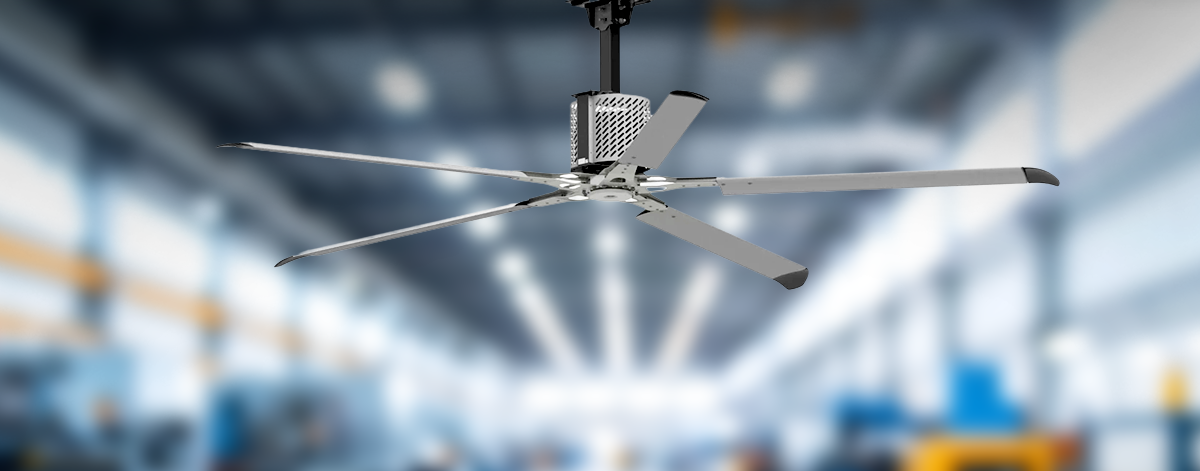
HVLS stands for High-Volume, Low-Speed. Unlike traditional fans, HVLS fans feature massive diameters ranging from 8 to 24 feet and utilize highly engineered, aerodynamic blades inspired by aircraft wings.
Instead of forcing a high-speed jet of air over a tiny area, an HVLS fan rotates slowly, moving an immense column of air downward toward the floor. When this massive column of air hits the ground, it disperses in all directions, creating a continuous, gentle "floor jet" that circulates throughout the entire facility.
By prioritizing air volume over air velocity, these systems deliver comprehensive, non-disruptive air movement across thousands of square meters with a single unit.
HVLS Fans vs. Traditional Industrial Fans
The operational differences between these two technologies reveal why legacy systems are rapidly becoming obsolete in modern industrial layouts.
| Feature | Traditional Industrial Fans | HVLS Fans |
| Airflow Characteristics | High speed, low volume, highly directional | Low speed, massive volume, uniform distribution |
| Coverage Area | Limited to a narrow, localized path | Up to 1,500+ square meters per fan |
| Energy Consumption | High per square meter (requires multiple units) | Exceptionally low (one unit replaces many small fans) |
| Noise Levels | Loud, disruptive aerodynamic drone | Whispering quiet, low-frequency operation |
| Aesthetic & Space | litters floor space or low walls with cords/mounts | Ceiling-mounted, clear of floor operations |
Key Reasons UAE Factories Are Switching to HVLS Fans
The transition to HVLS fans Dubai and across wider industrial zones is driven by measurable economic and operational advantages.
1. Superior Cooling and the "Evaporative Cooling" Effect
HVLS fans do not technically lower the thermodynamic temperature of a room on their own. Instead, they leverage the natural mechanics of human biology. The massive, continuous gentle breeze speeds up the evaporation of sweat from human skin. This creates a natural cooling effect that makes workers feel up to 3°C to 5°C cooler than the ambient air temperature.
2. Massive Energy Savings and Sustainability
Energy efficiency is a primary driver for procurement teams looking at warehouse cooling systems UAE. A single HVLS fan consumes a fraction of the electricity required to run the dozens of pedestal fans needed to cover the same footprint. Furthermore, when integrated alongside existing HVAC setups, HVLS fans allow facilities to raise their thermostat settings by a few degrees without sacrificing employee comfort, yielding massive reductions in peak summer cooling bills.
3. Boosting Worker Productivity and Safety
Heat stress is a serious liability in industrial environments. When core body temperatures rise, cognitive fatigue sets in, leading to slower reaction times, drops in production output, and an increased risk of workplace accidents. By stabilizing indoor conditions, factories protect their workforce, decrease absenteeism, and maintain steady production yields during peak summer months.
4. Condensation Management and Air Quality
UAE's coastal locations face intense humidity alongside high heat. When hot, humid air meets cooler indoor surfaces, condensation forms on concrete floors (often called "sweating slab syndrome"), raw materials, and machinery. This creates severe slipping hazards and rust risks. The uniform air circulation of HVLS fans balances surface temperatures, eliminating the thermal pockets where condensation forms.
Industries in the UAE Benefiting from HVLS Fans
A wide array of sectors are leveraging benefits of HVLS fans in factories to optimize their daily workflows:
- Logistics & Warehousing: Expansive high-bay facilities utilize them as primary warehouse ventilation and cooling systems UAE to keep stored goods safe from stagnant heat pockets.
- Manufacturing & Assembly Plants: Heavy industrial setups where localized heat from machinery makes traditional cooling impossible.
- Automotive Workshops: Facilities with large open bay doors where traditional air conditioning escapes instantly.
- Aviation Hangars: Massive open volumes requiring massive air movement without introducing high-velocity debris risks.
Choosing the Right HVLS Fan for Your Factory
Selecting the ideal system requires an evaluation of your specific layout by expert HVLS fan suppliers UAE. Key parameters to consider include:
- Ceiling Height: HVLS fans require proper clearance from the ceiling and any overhead obstructions (like cranes, lighting arrays, or sprinkler lines) to function safely and efficiently.
- Blade Diameter: Matching the fan size to the square footage of your floor layout ensures maximum coverage without over-specifying equipment.
- Environmental Obstructions: Internal structural pillars, high-density racking networks, and large machinery blocks alter airflow pathways and must be factored into the fan placement layout.
Return on Investment (ROI): The Financial Payback of Upgrading
When presenting a factory upgrade to executive leadership or procurement teams in the UAE, engineering benefits must be translated into financial metrics. While HVLS fans require a higher initial capital expenditure (CapEx) compared to standard pedestal fans, their total cost of ownership (TCO) flips the financial equation in your favor within months.
Investing in HVLS technology stabilizes operational costs in two major ways:
- The Productivity Payback: By dropping the perceived skin temperature of workers by up to 5°C, it mitigates heat-induced productivity drops, decreases absenteeism, and lowers the risk of workplace accidents during intense summer peaks.
- The HVAC Synergy: When paired with centralized industrial air conditioning, HVLS fans distribute cooled air uniformly. This allows you to raise thermostat settings by a few degrees without sacrificing comfort, yielding massive reductions in peak summer utility bills.
Conclusion: The Smarter Shift to Modern Cooling
The industrial landscape of the UAE is changing, and relying on outdated cooling methods is no longer economically viable. Relying on legacy industrial fans results in uneven airflow, excessive noise, high power bills, and unsafe working environments during intense summer peaks.
By installing large ceiling fans for industrial facilities, factory owners and facility managers can achieve uniform air circulation, drastic energy reductions, and a safer, more productive workplace. Making the switch to HVLS technology is an investment that quickly pays for itself in lowered utility bills, heightened asset protection, and an empowered workforce.For a standard manufacturing or logistics facility operating in the UAE, the combined return from power savings, avoided maintenance, and stabilized worker output allows an HVLS fan installation to achieve net-positive ROI within 12 to 24 months.
Frequently Asked Questions (FAQ)
HVLS (High-Volume, Low-Speed) fans are large-diameter ceiling fans that rotate slowly to move massive amounts of air downward. They create a continuous, gentle breeze over vast spaces, cooling occupants through enhanced natural evaporation rather than high-velocity blasts.
2.Why are UAE factories replacing traditional industrial fans with HVLS fans?
HVLS (High-Volume, Low-Speed) fans are large-diameter ceiling fans that rotate slowly to move massive amounts of air downward. They create a continuous, gentle breeze over vast spaces, cooling occupants through enhanced natural evaporation rather than high-velocity blasts.
3.Are HVLS fans energy efficient?
Yes. A single HVLS fan can replace a dozen or more traditional industrial fans while pulling minimal electrical wattage. When paired with commercial air conditioning, they allow facilities to run HVAC systems at higher target temperatures, drastically reducing overall energy expenses.
4.Can HVLS fans be used in warehouses and logistics facilities?
Yes. A single HVLS fan can replace a dozen or more traditional industrial fans while pulling minimal electrical wattage. When paired with commercial air conditioning, they allow facilities to run HVAC systems at higher target temperatures, drastically reducing overall energy expenses.