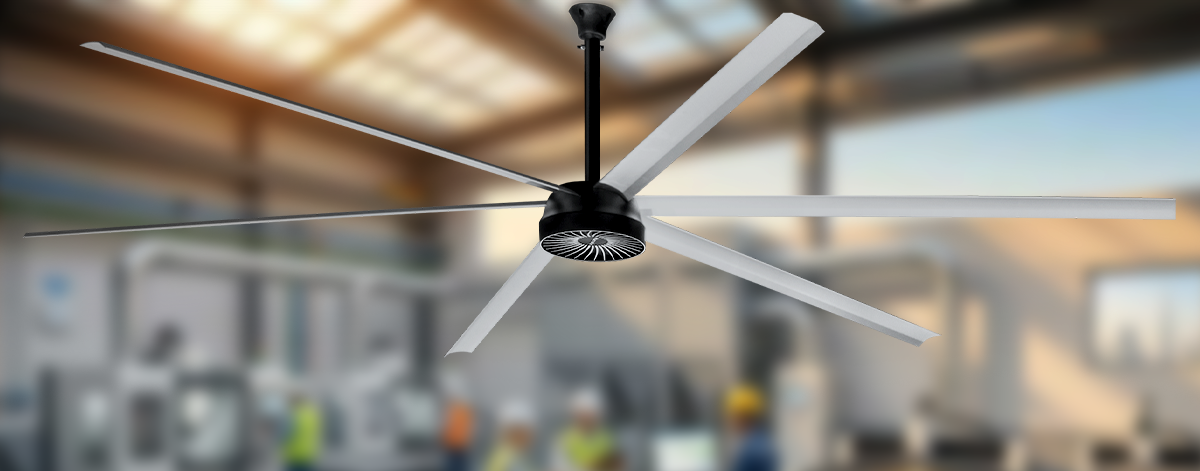
What Makes a Commercial HVLS Fan Suitable for Dubai’s Dusty Environment?
Dubai's industrial and commercial facilities don't get an easy version of summer. High temperatures, near-constant airborne dust, and round-the-clock operations put more strain on cooling equipment here than in most parts of the world. A fan that works fine in a mild climate can start struggling within months on a warehouse floor in Jebel Ali or Dubai Industrial City.
That's why the Commercial HVLS fans in Dubai facilities are built differently from standard ceiling fans. They're engineered specifically for heat, dust, and heavy-duty use. This article walks through what actually makes an HVLS fan suitable for these conditions and how to pick one that will hold up.
Why Dubai's Dusty Climate Demands Specialized Commercial Cooling
The Reality of Dubai's Industrial Environment
Anyone running a facility here already knows the challenges:
- Airborne dust and fine sand that gets in everywhere, from open loading bays to ventilation gaps
- Ambient temperatures that regularly climb past 45°C in summer
- Warehouses and factories are built with high ceilings, which makes airflow distribution tricky
- Operations that run continuously, with little downtime for equipment to rest or be serviced
Problems Dust Creates Inside Commercial Facilities
- Buildup on machinery and electrical components, which can shorten equipment life
- Poor indoor air circulation, especially in facilities with limited natural ventilation
- Reduced comfort for workers, particularly in warehouses without proper cooling
- Increased HVAC maintenance, as filters and coils clog faster
- Equipment overheating in poorly ventilated areas
- Higher cleaning costs as dust settles repeatedly on floors, racks, and surfaces
These conditions call for cooling systems that are designed, from the ground up, for dusty commercial environments, not general-purpose fans adapted to fit.
What Is a Commercial HVLS Fan?
HVLS stands for High Volume, Low Speed. Unlike small, fast-spinning fans, HVLS fans use large blades, typically ranging from 8 to 24 feet in diameter, that rotate slowly to move a large volume of air across a wide area.
This design difference matters. A cluster of small fans creates localized bursts of air with a lot of turbulence, while a single industrial HVLS fan in UAE businesses can circulate air evenly across an entire warehouse floor, keeping temperatures more consistent from wall to wall.
You'll typically find these fans in warehouses, distribution centers, manufacturing plants, gyms, aircraft hangars, and other large-footprint commercial spaces where commercial ceiling fans in Dubai buyers need coverage that a standard fan simply can't provide.
Key Features That Make Commercial HVLS Fans Suitable for Dubai's Dusty Environment
Not every HVLS fan performs equally in this climate. Before investing, facility managers in Dubai should look closely at a few specific engineering features.
Durable and Corrosion-Resistant Fan Blades
Blades made from aluminum or corrosion-resistant alloys hold up far better than standard materials in dusty, high-heat conditions. A protective coating helps prevent dust from clinging to the surface and reduces the corrosion risk that comes with airborne particles and humidity swings. Over time, this translates into a longer working lifespan and fewer replacements.
Sealed Motor and Protected Drive System
The motor is arguably the most vulnerable part of any industrial fan. Dust-resistant HVLS Fans use sealed motor housings and protected drive systems that keep fine particles out of internal components. This limits contamination, improves long-term reliability, and cuts down on the maintenance calls that come with dust-related wear.
Strong Mounting and Industrial Safety Features
Given their size, HVLS fans need to be mounted securely. Look for heavy-duty mounting hardware, backup safety cables, and a structural design suited to warehouse ceiling heights and load requirements. This isn't optional; it's a baseline safety requirement for any fan of this scale.
Low-Speed, High-Volume Airflow
Because HVLS fans move air gently rather than blasting it, they avoid the turbulence that smaller fans create. The result is consistent, wide-reaching air circulation instead of scattered hot and cold spots, a meaningfully different outcome than relying on several smaller fans placed around a facility.
Easy-to-Clean Blade Design
A smooth blade surface makes a practical difference in a dusty environment. Less surface texture means less dust clings to the blades, which keeps maintenance simpler and helps the fan maintain its airflow efficiency over time instead of gradually losing performance as grime builds up.
Smart Controls and Reliable Electronics
Variable speed control, programmable timers, and compatibility with building automation systems all add up to more stable, adaptable operation, useful in a facility where cooling needs shift between shifts, seasons, and occupancy levels.
How Commercial HVLS Fans Perform in Dubai's Dusty Environment
Rather than fighting dust head-on, HVLS fans work by improving overall airflow, which supports healthier and more efficient working conditions in several ways:
- Improves general ventilation across large spaces
- Prevents stagnant, hot air from settling in corners or near the ceiling
- Supports HVAC systems by helping distribute conditioned air more evenly
- Reduces heat stress for workers on the floor
- Improves overall comfort during long shifts
- Helps reduce moisture buildup in humid periods
- Operates efficiently, using relatively little energy for the coverage it provides
An important clarification: HVLS fans do not remove dust from the air, and they are not a substitute for dust extraction systems. They complement ventilation and filtration equipment by improving circulation, not by capturing or filtering particles.
Real-World Example: A Warehouse in Dubai Industrial Area
Consider a hypothetical logistics warehouse based in Dubai Industrial City. Loading bays stay open for much of the day, letting in heat and dust, while storage racks create pockets of stagnant air near the back of the facility. Workers report fatigue during peak afternoon hours, HVAC units run almost continuously trying to keep up, and airflow across the floor is uneven, some zones stay cooler while others turn into hot spots.
After installing HVLS fans across the main floor, airflow becomes noticeably more even. Temperature differences between zones shrink, worker comfort improves, and the HVAC system doesn't need to run as hard to maintain a stable indoor climate, which shows up as a reduction in energy bills over time.
This scenario is illustrative rather than a measured case study, but it reflects the kind of outcome many Dubai facilities report after switching to HVLS systems.
Things to Consider Before Installing HVLS Fans
HVLS fans aren't the right fit for every space, and it's worth going in with realistic expectations:
- The upfront investment is higher than buying several small fans
- Facilities need adequate ceiling height for safe, effective installation
- Professional installation is required, given the size and weight of the units
- They are not a replacement for dedicated dust extraction systems
- Proper sizing matters, an undersized fan will not deliver the airflow a large space actually needs
Being upfront about these points matters more than making the case sound one-sided. A fan that's mis-sized or poorly installed won't deliver the results a facility is paying for.
How to Choose the Right Commercial HVLS Fan in Dubai
With the local conditions in mind, here's what to check before deciding on a supplier or model:
- Airflow capacity relative to your facility's square footage and ceiling height
- Motor efficiency and power consumption
- Dust-resistant construction, particularly around the motor housing
- Blade material and coating quality
- Compatibility with your ceiling height
- Safety certifications for mounting and structural load
- Warranty terms and coverage
- Availability of local installation support
- Spare parts availability in the UAE
- The supplier's track record and experience working in UAE conditions
Why Choose KHIND Solutions for Commercial HVLS Fans in Dubai?
KHIND Solutions brings industrial cooling expertise built specifically around the demands of the UAE climate. Their range of energy-efficient fans in Dubai businesses can rely on pairs of high-performance motors with construction designed to withstand heat and dust, backed by engineering consultation, professional installation, and ongoing maintenance support.
What that looks like in practice:
- High-quality commercial HVLS fans built for demanding environments
- Reliable, consistent airflow across large facilities
- Durable construction that holds up under continuous use
- Low maintenance requirements
- Professional installation by experienced technicians
- Local UAE-based support and spare parts availability
- Long-term warranty coverage for peace of mind
For facilities searching for the best commercial HVLS fans for dusty environments in Dubai, working with a supplier that understands local operating conditions makes a measurable difference in long-term performance.
Dubai's dusty, high-heat industrial conditions demand more than an ordinary commercial fan. A properly specified HVLS fan, with sealed motors, corrosion-resistant blades, and a build suited to continuous operation, delivers better airflow, lower energy costs, improved worker comfort, and a longer equipment lifespan than standard alternatives.
Looking for the best commercial HVLS fans for dusty environments in Dubai? Contact KHIND Solutions to find the ideal airflow solution for your facility.
FAQ
Yes. Commercial HVLS fans with sealed motors, corrosion-resistant blades, and durable construction are designed to perform reliably in dusty industrial environments. They improve airflow while requiring minimal maintenance.
Do HVLS fans spread dust in a warehouse?
No, not under normal operating conditions. Because HVLS fans rotate at low speeds, they create smooth, consistent airflow rather than the high-velocity turbulence produced by smaller fans. Proper housekeeping and ventilation should still be maintained.
Can HVLS fans replace industrial dust extraction systems?
No. HVLS fans are designed to improve airflow and thermal comfort, not to remove airborne dust or contaminants. Dust-resistant industrial ceiling fans installed in UAE facilities should be paired with dedicated dust extraction and ventilation systems wherever dust control is a priority.
What type of HVLS fan blade is best for dusty environments?
Aluminum or corrosion-resistant alloy blades with smooth finishes are ideal for dusty environments because they resist corrosion, accumulate less dust, and are easier to clean and maintain.